
Scott Aniol
Ministry, Worship, Culture, Aesthetics
Publications
An audio recording of “Citizens and Exiles,” a lecture by Scott Aniol at the Metropolitan Tabernacle Theology Conference in London (2018).
Book Review: The Worship Pastor by Zac Hicks
In this review of Zac Hicks’s The Worship Pastor: A Call to Ministry for Worship Leaders and Teams (Zondervan, 2016), published in Artistic Theologian 6 (2018), Aniol welcomes the book’s call for worship leaders to shepherd congregations rather than perform. He commends Hicks’s recognition that worship leadership shapes belief and that musical forms are not neutral.
Aniol also identifies weaknesses. The book offers no substantive biblical case for worship leadership as a pastoral office and downplays pastoral qualifications. And although Hicks rejects the idea of worship leaders “ushering” people into God’s presence, Aniol argues that he assumes a charismatic theology of God’s presence and emotional flow throughout.
A video recording of “A Biblical Definition of Culture,” a lecture by Scott Aniol at the Metropolitan Tabernacle Theology Conference in London (2018).
An audio recording of “A Biblical Definition of Culture,” a lecture by Scott Aniol at the Metropolitan Tabernacle Theology Conference in London (2018).
In this article on Ephesians 5:19 and Colossians 3:16, Scott Aniol examines what Paul meant by “psalms, hymns, and spiritual songs,” a phrase frequently invoked in contemporary worship debates. Surveying both popular and recent scholarly interpretations of the three Greek terms, he argues that they are best understood not as distinct categories of congregational song but as overlapping near synonyms, each of which also appears in psalm titles in the Septuagint.
Aniol then draws out the implications: the passages clearly call churches to sing the inspired Old Testament psalms, but on their own they neither prove nor rule out singing other songs, and they cannot be used to defend either side of today’s style debates. The article appeared in Artistic Theologian 6 (2018): 13–18.
In this article on Baptist ecclesiology and the regulative principle of worship, Scott Aniol contrasts the Reformed form of the principle with the historic Baptist position. The Reformed tradition, rooted in Calvin and codified in the Heidelberg Catechism, has distinguished the substance of worship, which requires clear biblical warrant, from its forms or circumstances, which may be decided without specific biblical direction. Aniol argues that Baptists, by contrast, have historically and theologically insisted on New Testament warrant for both the substance and the forms of church practice. The article was published in the Journal for Baptist Theology and Ministry 15, no. 1 (Spring 2018).
Korean translation of Worship in Song, translated by Dr. Tom Song and published in South Korea.
This message on repentance through singing in corporate worship was given by Scott Aniol at the National Center for Family Integrated Churches conference in Asheville, North Carolina, whose theme was “Repentance: The Reformation Continues.” Aniol preached from Psalm 130, one of the seven penitential psalms, to show how song can express true repentance, and introduced Martin Luther’s paraphrase of the psalm, “Out of the Depths I Cry to Thee.”
This sermon on Psalm 130 considers repentance through singing in corporate worship. Aniol argues that poetry set to music forms God’s people holistically, and that this is as true of repentance as of praise and thanksgiving: congregational songs of confession shape believers to live aware of their sin and their daily need of cleansing through the blood of Christ. The message was given at the 2017 National Center for Family-Integrated Churches National Conference.
This book of hymns is a modest attempt to collect some of the best congregational songs available in the English language. No hymnal is perfect or adequate on its own. Yet it is our prayer that this modest collection will give honor to the living God and aid His people in singing His praises.
This sermon on Psalm 137 explores worship in exile, tracing how Israel’s idolatry led to the Babylonian captivity and what the psalm’s lament meant for God’s people by the waters of Babylon. Aniol argues that this often-neglected psalm is deeply relevant for Christians, who are called to seek the welfare of the culture around them without compromising pure worship while longing for the new Jerusalem. Preached at Christ the King in Fort Worth, Texas, on March 12, 2017.
This video records a chapel sermon by Scott Aniol on drawing near to God in worship from Hebrews 10:19–22, preached at Southwestern Baptist Theological Seminary on September 5, 2017.
Book Review: The Benedict Option by Rod Dreher
In this review of Rod Dreher’s The Benedict Option: A Strategy for Christians in a Post-Christian Nation (Sentinel, 2017), published in Detroit Baptist Seminary Journal 22 (2017), Aniol argues that Dreher’s proposal is not a call to withdraw from culture. Instead, it is a needed correction for an American Christianity that has become as secular as the surrounding culture. He summarizes Dreher’s account of Western decline and his Benedictine principles of order, prayer, work, asceticism, stability, community, hospitality, and balance.
Writing as a conservative Baptist, Aniol judges Dreher’s assessment and solutions sound and essentially biblical. He notes reservations about a few practical suggestions and about cross-denominational cooperation that lacks careful doctrinal distinctions.
Was the hymn writer Isaac Watts a Unitarian? In this article, Scott Aniol investigates Watts’s mature thought on the Trinity, tracing the charges made against him and the rise of Unitarianism among early eighteenth-century English Nonconformists. He shows that Watts never intended to argue against the Trinity or the deity of Christ, but that his search for a rational explanation of the doctrine and his refusal to make any human formulation, including the Athanasian Creed, a test of fellowship left him open to suspicion.
Aniol draws implications for setting doctrinal boundaries for Christian cooperation and for the value of historic creeds, and observes that Watts’s strongly Trinitarian hymns have shaped believers far more than his treatises. Published in the Detroit Baptist Seminary Journal 22 (2017): 91–103.
This video recording presents Scott Aniol’s paper on whether Isaac Watts was a Unitarian, later published in the Detroit Baptist Seminary Journal 22 (2017). Aniol examines Watts’s mature views of the Trinity and the controversies surrounding them, concluding that Watts’s unusual explanations and his refusal to make creeds a test of fellowship, rather than any denial of Christ’s deity, fueled the charges, while his Trinitarian hymns left a lasting orthodox legacy.
This video recording presents Scott Aniol’s paper “Practice Makes Perfect: How Corporate Worship Forms Disciples.” Aniol argues that corporate worship forms disciples not only by teaching doctrine but by shaping the heart’s inclinations through habitual practice, and that gospel-shaped liturgies help believers become what they are in Christ. A version was published in the Journal of Spiritual Formation & Soul Care (2017).
In this article on corporate worship and discipleship, Scott Aniol argues that corporate worship is one of the primary means of making disciples through the ritual formation of spiritual virtue. Because people act chiefly according to the inclinations of their hearts, disciple-making must address those inclinations as well as doctrine, and such inclinations are shaped most significantly by habitual practices in community.
Aniol therefore explores how the liturgies of corporate worship embody values and form worshipers, urging pastors to use biblical liturgies that reenact the gospel, so that by rehearsing what they are in Christ, believers become what they are. Published in the Journal of Spiritual Formation & Soul Care 10, no. 1 (2017): 93–104.
This conference address asks whether differences over philosophy of culture and worship should affect cooperation among Christians. Aniol defines a conservative philosophy of culture by two pillars, belief in transcendent absolute principles and the importance of aesthetic form, then distinguishes the gospel as the boundary of Christian unity from secondary matters. He argues that philosophy of culture and worship ranks high among secondary issues and must shape the extent of cooperation. Delivered at the Conference on the Church for God’s Glory in Rockford, Illinois.
Sonidos de adoración is the Spanish translation of Scott Aniol’s Sound Worship: A Guide to Making Musical Choices in a Noisy World, offered by Chapel Library as an ebook in PDF, ePub, and Mobi formats. Like the English original, it is a short book about making musical choices for worship and for life that are deliberately informed by the Word of God.
The original edition walks through, in six brief chapters, the main questions that shape how Christians choose music today. It aims to help readers choose music with discernment and wisdom, choosing what is beneficial and edifying and what brings glory to God.
This sermon on 1 Kings 18:1–40 draws lessons from Elijah’s confrontation with the prophets of Baal on Mount Carmel, read as a worship war recorded for a people in exile. Aniol warns against syncretism, pragmatic compromise, and borrowing from pagan worship, and calls believers to worship God alone, confront idolatry even at personal cost, and seek the Lord with all their heart. Preached at Christ the King in Fort Worth, Texas, on May 29, 2016.
In this conference address on the regulative principle of worship, Aniol develops the thesis of his book By the Waters of Babylon that the aesthetic forms God inspired in Scripture should inform and regulate the cultural forms churches use in worship. Responding to reviewers who asked for clarification, he grounds the argument in verbal plenary inspiration, contending that biblical truth includes the affections and imagination conveyed through inspired literary forms. This audio recording is from the 2016 Religious Affections conference at High Country Baptist Church, Colorado Springs, and includes discussion.
This video recording presents Aniol’s address “Form and Substance,” which extends the regulative principle of worship to the aesthetic forms of Scripture. Building on his book By the Waters of Babylon and on the doctrine of verbal plenary inspiration, he argues that the poetic and literary forms God chose to communicate his truth should shape the forms churches use in corporate worship today. Recorded at the 2016 Religious Affections conference at High Country Baptist Church in Colorado Springs, followed by questions and discussion.
This sermon on Revelation 3:14–20 addresses communion with God, the first of the three priorities that shape the ministry of Christ the King in Fort Worth, Texas. Aniol argues that Christ’s words to the lukewarm church in Laodicea are primarily an invitation to believers, picturing communion with God as table fellowship, and he calls listeners to renew that fellowship through Scripture, prayer, corporate worship, and the Lord’s Table. Preached September 4, 2016.
This sermon on Acts 5:12–42 considers what Christians should do when the commands of God and the commands of human authorities conflict. From the apostles’ reply that “we must obey God rather than men,” Aniol urges believers to distinguish genuine persecution from the loss of comforts, and to respond to conflict with courage, respect, and continued proclamation of the gospel. Preached at Christ the King in Fort Worth, Texas.
This sermon on John 15:1–11 introduces the first of three priorities that describe the church’s philosophy of ministry: our relationship with God through Christ. Aniol expounds Jesus’ teaching on the vine and the branches, stressing that fruitfulness depends on abiding in Christ, and shows how the Lord’s Table unites all three priorities. Preached at Christ the King in Fort Worth, Texas, on October 4, 2015.
How should churches respond to this seismic shift in their relationship with an increasingly post-Christian culture while still following the biblical mandate to reach that culture with the gospel of Jesus Christ?
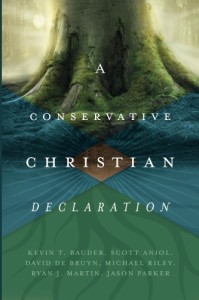
A Conservative Christian Declaration is a jointly authored statement by Kevin T. Bauder, Scott Aniol, David de Bruyn, Michael Riley, Ryan J. Martin, and Jason Parker that reaffirms a commitment to historic, conservative Christianity. The authors affirm that there are transcendent and absolute principles of truth, goodness, and beauty, that these principles can be known, and that Christians and their ministries should be aligned with them in pursuing the whole counsel of God.
The declaration also commits its signers to conserving the institutions and forms that best reflect this transcendent order. Written out of love for Christ, the gospel, Scripture, and the church, it aims to help churches preserve and nourish biblical Christianity by setting out what the Bible teaches about truth, goodness, beauty, and rightly ordered affections in life and ministry.
This article addresses the origins of Hebrew worship and the claim, common among secular scholars, that Israel’s monotheistic worship evolved naturally from the polytheistic religions of its Near Eastern neighbors. Scott Aniol explains the similarities often cited, such as shared divine names and parallels with the Ugaritic texts, and surveys common answers to the question of similarity.
He concludes that worldview bias plays a significant role in the conclusions drawn from the available evidence, and that non-theists who challenge the historical reliability of the biblical record do so only on the basis of the biblical worldview they reject. Published in Answers Research Journal 8 (2015): 33–39.
This video recording presents Scott Aniol’s paper on worldview bias and the origin of Hebrew worship, read during a colloquium at Southwestern Baptist Theological Seminary. Aniol responds to scholars who claim Israel’s worship evolved from neighboring polytheism, arguing that their conclusions owe much to worldview bias. The paper was published in Answers Research Journal 8 (2015).
This audio recording presents Aniol’s talk on Christian education, which builds on Douglas Wilson’s Recovering the Lost Tools of Learning to ask how educators can teach children not only to know what is lovely but to love it. Aniol proposes the Christian tradition of beauty, or rightly ordered loves, as the missing link between right thinking and right action, aiming at students formed in mind, will, and emotions.
This Thanksgiving-season sermon on 2 Corinthians 4:15 examines the place of gratitude in worship. Aniol argues that thanksgiving for grace received is a central expression of worship that brings glory to God, drawing on the Psalms and Jonah 2:9 to show how Scripture links praise with humble acknowledgment of undeserved salvation. Preached at Christ the King in Fort Worth, Texas, on November 23, 2014.
This paper examines the role of worship philosophy and practice in both dividing and unifying Protestant denominations. Scott Aniol shows that during the Reformation, disagreements over worship, including the Lord’s Table, baptism, and how Scripture regulates worship, were central to denominational divisions, and that traditional psalmody, hymnody, and liturgy later fostered appropriate unity across denominational lines.
He then argues that two recent developments, the Praise and Worship movement and the Church Growth movement, have blurred denominational distinctives and contributed to denominational decline, partly by elevating musical style as central to church identity. The paper was presented at the 2014 Southwest Regional Meeting of the Evangelical Theological Society.
A video recording of Scott Aniol’s lecture “Toward a Biblical Understanding of Culture.”
In this paper on the missional church movement and evangelical worship, Scott Aniol surveys the history, literature, and theology of the movement, from the ecumenical missio Dei discussions and Lesslie Newbigin to North American writers such as Darrell Guder, Ed Stetzer, and Alan Hirsch. He identifies the principles that guide missional worship, including its emphasis on incarnation and contextualization.
Aniol acknowledges strengths in the movement but identifies weaknesses in three areas: its view of the nature of culture, its posture of contextualization, and its understanding of the relationship between worship and evangelism. The paper was presented at the November 2013 national meeting of the Evangelical Theological Society.
This audio recording presents Scott Aniol’s paper assessing the missional church movement’s impact on evangelical worship philosophy and practice, delivered at the 2013 national meeting of the Evangelical Theological Society. Aniol traces the movement’s history and theology and evaluates its views of culture, contextualization, and the relationship between worship and evangelism.
An audio recording of a sermon by Scott Aniol on John 17:1–26 concerning the mission Jesus has given his people.
This video recording from Religious Affections Ministries features Scott Aniol on how to evaluate musical communication, a topic related to choosing music for worship. It was published in 2013.
A video recording of Scott Aniol’s message “Holy Culture” on 1 Peter 1, published by Religious Affections Ministries (2013).
Gospel-Shaped Worship: A Review of Recent Literature
This review essay on gospel-shaped liturgy, published in Artistic Theologian 2 (2013) as “Gospel-Shaped Worship: A Review of Recent Literature,” examines four books that argue the structure of Christian worship should follow the shape of the gospel. The books are Bryan Chapell’s Christ-Centered Worship, Robbie F. Castleman’s Story-Shaped Worship, Mike Cosper’s Rhythms of Grace, and James K. A. Smith’s Imagining the Kingdom.
Aniol weighs each book’s strengths and weaknesses. He concludes that all four offer a welcome corrective to worship that lacks biblical or theological structure. If he had to choose only one, he would recommend Castleman’s for its balance of scholarship and accessibility.
An audio recording of a sermon by Scott Aniol on drawing near to God in worship from Hebrews 10 (2013).