
Scott Aniol
Ministry, Worship, Culture, Aesthetics
Publications & Media
Book Review: Story-Shaped Worship by Robbie F. Castleman
Aniol’s review of Robbie F. Castleman’s Story-Shaped Worship: Following Patterns from the Bible and History (InterVarsity Press, 2013) appeared in Artistic Theologian 2 (2013) as part of his review essay “Gospel-Shaped Worship: A Review of Recent Literature.” He commends Castleman’s accessible yet substantial case that ordered worship should reenact the gospel story as patterned in Scripture and church history. He sees the absence of Communion from her pattern of worship as the book’s main weakness, and he questions her rejection of the regulative principle. Of the books in the essay, though, this is the one he recommends most for pastors and church musicians.
Book Review: Rhythms of Grace by Mike Cosper
Aniol’s review of Mike Cosper’s Rhythms of Grace: How the Church’s Worship Tells the Story of the Gospel (Crossway, 2013) appeared in Artistic Theologian 2 (2013) as part of his review essay “Gospel-Shaped Worship: A Review of Recent Literature.” He notes that the book is written for a popular audience and draws on Bryan Chapell and James K. A. Smith. He values its Creation-Fall-Redemption-Consummation framework for liturgy and its account of how revivalism displaced gospel-shaped worship. However, he judges the final two chapters loosely connected to the argument. He also finds Cosper’s claim that musical form is neutral at odds with his own case that worship forms us.
Book Review: Imagining the Kingdom by James K. A. Smith
Aniol’s review of James K. A. Smith’s Imagining the Kingdom: How Worship Works (Baker Academic, 2013) appeared in Artistic Theologian 2 (2013) as one section of his review essay “Gospel-Shaped Worship: A Review of Recent Literature.” He commends Smith’s argument that the form of liturgy shapes the imagination and affections and that form and content cannot be separated. He questions three things: Smith’s grounding of Christian action in the missio Dei and cultural transformation, his failure to distinguish bodily impulses from spiritual affections, and his minimizing of propositional doctrine. Even so, Aniol recommends the book for pastors, church leaders, and students of worship.
Book Review: Doxology and Theology ed. by Matt Boswel
In this review of Doxology and Theology: How the Gospel Forms the Worship Leader, edited by Matt Boswell (B&H, 2013), published in Artistic Theologian 2 (2013), Aniol surveys the book’s fourteen chapters by various worship leaders. The book grew out of a conference of the same name and argues that theology is for every Christian, especially worship leaders. Aniol agrees with Boswell that worship leaders serve at least as functional elders and need theological grounding, and he calls the book a welcome corrective. However, he doubts that every chapter follows from its thesis, citing Aaron Ivey’s chapter on social justice. He also sees the book as only a starting point.
Book Review: A Neglected Grace by Jason Helopoulos
In this review of Jason Helopoulos’s A Neglected Grace: Family Worship in the Christian Home (Christian Focus, 2013), published in Artistic Theologian 2 (2013), Aniol describes the book as a motivational and practical guide. It grounds family worship in Scripture and parental responsibility and encourages families to pursue it with joy rather than legalism. He praises its tips, resources, and understanding tone. He notes, though, that it is only an introduction, and that a fuller theology of worship and of how children are spiritually formed is needed to correct common misconceptions. He nevertheless recommends it highly.
This audio recording presents “God Is Really Among You: The Evangelistic Impact of God-Centered Worship,” a session Scott Aniol gave at the Wilds Christian Camp and Conference Center Music Conference in early January 2012. Aniol noted that the session drew on his paper “Toward a Biblical Understanding of Culture.”
This document accompanies “God Is Really Among You: The Evangelistic Impact of God-Centered Worship,” a session Scott Aniol presented at the Wilds Christian Camp and Conference Center Music Conference in early January 2012. Aniol based the session on his paper “Toward a Biblical Understanding of Culture,” which is the document linked here. An audio recording of the session is also available.
This audio recording presents “Train Up a Child: Teaching the Next Generation to Worship,” a workshop on children and worship that Scott Aniol taught at the Wilds Christian Camp and Conference Center Music Conference in early January 2012.
These are Scott Aniol’s notes for “Train Up a Child: Teaching the Next Generation to Worship,” a workshop on children and worship given at the Wilds Christian Camp and Conference Center Music Conference in early January 2012. Aniol described the notes as sketchier than his other sessions, drawing on earlier writing along with some new material. An audio recording of the workshop is also available.
An audio recording of Scott Aniol’s lecture “Toward a Biblical Understanding of Culture.”
This audio recording presents Aniol’s conference paper on what God said about worship, given at the Conference on the Church for God’s Glory in Rockford, Illinois. Aniol argues that worship is rooted in God’s own speech: his self-revelation is the basis of worship, his word through his Son is its means, and what he has said regulates the elements of corporate worship.
In this paper on biblical worship, Aniol argues that God did not merely say something about worship; worship itself is grounded in what God has said. He traces how God’s self-revelation is the basis of worship, how sin prevents it, and how God’s speech through his Son makes it possible, describing worship as drawing near to God in dialogue: hearing his Word and responding with fitting affection.
The paper concludes by applying the regulative principle to corporate worship, arguing that God alone determines its acceptable elements and that churches should therefore keep services simple. It was presented at the Conference on the Church for God’s Glory in Rockford, Illinois.
This audio recording presents “Conservative Christianity 101,” a session Scott Aniol gave at the Wilds Christian Camp and Conference Center Music Conference, held in early January 2012. Aniol posted the notes and audio from this and his other conference sessions on the Religious Affections Ministries website.
These are Scott Aniol’s session notes for “Conservative Christianity 101,” presented at the Wilds Christian Camp and Conference Center Music Conference in early January 2012, where he was a keynote and workshop speaker. An audio recording of the session is also available.
Book Review: Creation Regained: Biblical Basics for a Reformational Worldview by Albert Wolters
In this review of Albert M. Wolters’s Creation Regained: Biblical Basics for a Reformational Worldview (2nd ed., Eerdmans, 2005), published in Artistic Theologian 1 (2012), Aniol places the book within the Neo-Calvinist, transformationalist approach to culture. He summarizes its creation-fall-redemption framework and its categories of structure and direction. He criticizes Wolters for conflating God’s creation with human creations, for failing to distinguish basic elements from the forms they take, and for caricaturing the two kingdom view. Still, he concludes that the book gives a clear and engaging portrait of the transformationalist position.
In this article on the biblical understanding of culture, Scott Aniol examines how the missional church movement defines culture, since its emphases on incarnation and contextualization depend on that definition. He traces the modern concept of culture through eighteenth-century German thought and the rise of cultural anthropology, then compares it with New Testament categories related to ethnicity, “the world,” and behavior.
Aniol concludes that the New Testament terms closest to the modern idea are those describing a people’s way of life or conduct. Because conduct flows from beliefs and values, culture is not neutral; rather than religion being a component of culture, culture is a component of religion, and every cultural expression must be evaluated by the values it embodies. Published in Artistic Theologian 1 (2012): 40–56.
This video, posted by Religious Affections Ministries in 2013 under the title “Holy Culture,” accompanies Scott Aniol’s article “Toward a Biblical Understanding of Culture” (Artistic Theologian, 2012). That article critiques the missional church movement’s understanding of culture and argues from New Testament categories that culture is a people’s way of life flowing from their beliefs and values, and so is never neutral.
This audio recording presents Scott Aniol’s talk “Preserving the Truth in Our Worship” (2011), on conservative worship and the preservation of biblical truth. In the companion paper of the same title, Aniol argues that truth is preserved only when it is rightly imagined, and that the forms of corporate worship a church uses shape how its people imagine the truths of Scripture.
In this paper, Aniol argues that conservative worship is essential to the preservation of truth, because truth is preserved successfully only when it is rightly imagined, and right imagination depends heavily on the forms of worship a church employs. He contends that biblical truth is more than factual correspondence, noting that Scripture comes largely in literary and poetic forms rather than bare propositions, and he explores the relationship of truth to the moral imagination, to worship forms, and to tradition.
Against the popular distinction between theological and cultural conservatism, Aniol maintains that theological conservatism cannot last without cultural conservatism. He concludes that churches should preserve forms that express doctrine in the ways Scripture does, nurture the Judeo-Christian worship tradition, and pass that tradition to their children by immersing them in worship early.
This video recording from Religious Affections Ministries features Scott Aniol speaking on truth in corporate worship. It is listed on Vimeo under the title “Communicating Truth in Worship.”
Book Review: Art in Action: Toward a Christian Aesthetic by Nicholas Wolterstorff
In this 2011 review of Nicholas Wolterstorff’s Art in Action: Toward a Christian Aesthetic, Aniol summarizes Wolterstorff’s challenge to the modern view that art exists mainly for passive aesthetic contemplation. Wolterstorff argues instead that works of art serve a wide range of human actions, including liturgy. Aniol finds the argument persuasive in its humbling of the artist as a servant. However, he argues that Wolterstorff overcorrects by treating disinterested aesthetic delight as inferior to function, which strips art of its intrinsic worth. Even so, he regards the book as an enlightening introduction to a Christian aesthetic.
Was Isaac Watts a proto-dispensationalist? Some dispensationalists have cited the hymn writer as evidence that dispensational ideas predate John Nelson Darby. In this article, Scott Aniol compares Watts’s writings with the essential distinctives of dispensationalism, examining Watts’s hermeneutic, his view of Israel and the church, and the unifying principle of his theology.
Aniol concludes that Watts was no proto-dispensationalist, though he shared with dispensationalists a love for Scripture, a belief in God’s sovereign and unified plan for history, a desire to understand the progress of revelation, and a longing for Christ’s return. Published in the Detroit Baptist Seminary Journal 16 (2011): 1–22.
This audio recording presents Scott Aniol’s paper “Was Isaac Watts a Proto-Dispensationalist?”, published in the Detroit Baptist Seminary Journal (2011). Aniol compares Watts’s hermeneutic and his view of Israel and the church with the distinctives of dispensationalism and concludes that Watts was not a proto-dispensationalist, while noting the convictions he shared with dispensationalists.
This audio recording is the second of two lessons on the hymnody of the Christian church. Aniol argues that cultural forms are cultivated over long periods, then surveys hymnody in the Judeo-Christian tradition from Old Testament and early church song through medieval and Reformation hymns to the Enlightenment and the new tradition that followed. He urges churches to cultivate forms that nurture noble affections and to pass that tradition to their children. Recorded at Bethany Bible Church in June 2010.
In this essay on the history of Christian hymnody, Aniol surveys the development of church music to answer common appeals to Luther, Bach, Watts, and Wesley in defense of contemporary worship. Building on the claim that form shapes content, he argues that cultural forms are cultivated over long periods and express value systems, and he traces a largely continuous Judeo-Christian tradition of hymnody from Scripture through the Reformation.
Aniol then describes how the Enlightenment and nineteenth-century revivalism, especially Charles Finney’s pursuit of excitement, set the church on a second road that adopted popular musical forms. He closes by urging churches to recognize the importance of form, to distinguish forms that nurture noble affections from those that excite base passions, to cultivate the historic tradition, and to pass it on to their children.
This audio recording is the first of two lessons on the hymnody of the Christian church, focusing on function and form. Aniol surveys the biblical mandate for congregational song and the purpose and power of hymns, then examines how word choice, poetic meter, melody, rhythm, harmony, and performance shape a hymn’s content and the affections it expresses. Recorded at Bethany Bible Church in June 2010.
In this paper on Christian hymnody, Aniol considers what Scripture says about the church’s songs and why hymns matter, arguing that form shapes content. After defining the term “hymn” and discussing psalms, hymns, and spiritual songs, he analyzes the anatomy of a hymn, showing how word choice, poetic meter, melody, rhythm, harmony, and performance shape the affections a text expresses.
He concludes that because hymns express affections to God, some are fitting for worship and some are not, so Christians must discern their meaning. This is the first of a two-part series on the hymnody of the church.
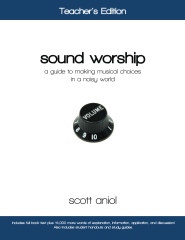
The Teacher’s Edition for Sound Worship: A Guide To Making Musical Choices in a Noisy World by Scott Aniol includes the full text of the book, 14,000 additional words of instruction, illustration, explanation, discussion questions, student handouts, and more.
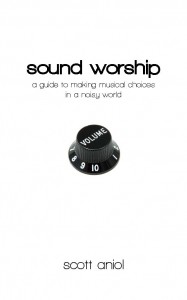
This is a book about making musical choices. But not just any choices. This is a book about making musical choices that are deliberately informed by the Word of God. It is about making choices that are discerning, wise, beneficial, and edifying. This book is about making musical choices that will bring glory to God.
This video recording from Religious Affections Ministries features Scott Aniol speaking on preparation for and participation in corporate worship.
This audio recording presents Aniol’s talk on how conservative Christians can preserve biblical worship and pass it to the next generation. Following Paul’s charge to deliver the whole counsel of God, he proposes four commitments: worship regulated by the Word of God, forms that foster ordinate affection toward God, forms nurtured within the community of faith, and transmission of those forms to future generations.
In this paper on conserving biblical worship, Aniol asks what it will take for churches to transmit worship that is acceptable to God to the next generation. Written for pastors and church leaders, it argues that conservative Christians must commit to worship regulated by the Word of God, to forms that foster ordinate affection toward God, to forms nurtured within the community of faith, and to deliberately passing those forms to their children.
Aniol stresses that the aim is not loyalty to tradition for its own sake but faithfulness to the whole counsel of God. The material was also published as a six-part series by Religious Affections Ministries.

Wars are raging. These are not wars of flesh and blood, but of ideas – ideas about music and its role in life and the Church. Worship in Song attempts to address these important and sometimes controversial issues from a Scriptural foundation.
Book Review: Christ-Centered Worship by Bryan Chapell
In this review of Bryan Chapell’s Christ-Centered Worship: Letting the Gospel Shape Our Practice (Baker Academic, 2009), published in Themelios 34 (2009), Aniol traces Chapell’s argument that “structures tell stories” and that a Christian liturgy should therefore re-present the gospel. Chapell finds common elements in historic liturgies and biblical examples, from adoration and confession through assurance, thanksgiving, petition, instruction, charge, and blessing. Aniol calls the book an engaging exploration that pastors will benefit from, while allowing for disagreement on some specific applications.
In this paper on music and emotion, Aniol aims to help believers apply the Bible to their musical choices by correcting presuppositions he believes Modernism and Postmodernism introduced, which opened the way for Revivalism and Charismaticism to shape views of worship. He addresses biblical authority on matters Scripture does not directly address and argues that music communicates through emotional metaphor and that spiritual affections are distinct from physical feelings.
Contrasting Dionysian and Apollonian forms of art, Aniol urges churches to reject music that manipulates physical feeling and to favor simple, rich hymns with strong texts and modest music. The paper was first prepared for a class at Bob Jones Seminary in November 2008.
Book Review: God’s Word, the Final Word on Worship and Music by Dean Kurtz
In this 2008 review of Dean Kurtz’s God’s Word, the Final Word on Worship and Music: A Biblical Study, Aniol recommends the book as a helpful resource. It surveys worship and music from Genesis to Revelation and pairs exegesis of key passages with principles and applications. He commends Kurtz’s grasp of key categories: the distinction between pop and folk culture, concern over manufacturing feelings in contemporary worship, the dangers of trivial children’s sacred music, 1 Corinthians 8–10 and sinful associations, and culture and multiculturalism. He disagrees with Kurtz’s classification of revivalist gospel songs as folk music.
Undergraduate, 15 hours
International Baptist College, 2007
01 Aniol Seminar in Theology of Worship
02 Aniol Seminar in Theology of Worship
03 Aniol Seminar in Theology of Worship
04 Aniol Seminar in Theology of Worshi
05 Aniol Seminar in Theology of Worship
06 Aniol Seminar in Theology of Worship
07 Aniol Seminar in Theology of Worship
08 Aniol Seminar in Theology of Worship
09 Aniol Seminar in Theology of Worship
10 Aniol Seminar in Theology of Worship
11 Aniol Seminar in Theology of Worship
12 Aniol Seminar in Theology of Worship
13 Aniol Seminar in Theology of Worship